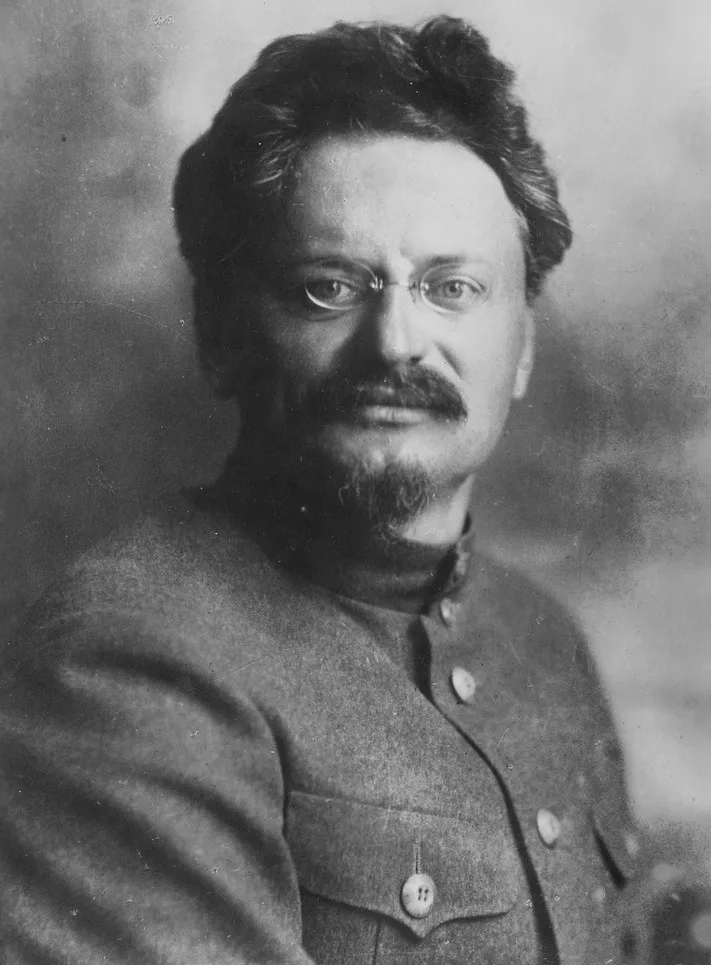
 Leon Trotsky
23 definitions
Leon Trotsky
Leon Trotsky
1879 – 1940
Definition.com
The Bourgeoisie (n.) is vitally interested in imposing its moral philosophy upon the exploited masses with concrete norms concealed under moral abstraction.
Definition.com
Bureaucracy (n.) is inversely proportional with social harmony.
Definition.com
Fascism (n.) is nothing but capitalist reaction.
Definition.com
Fascism (n.) is the last resource of the bourgeoisie which replaces social and historical criteria with biological and zoological standards so as thus to free itself from any and all restrictions in the struggle for capitalist property.
Definition.com
Fascism (n.) is what comes only when the working class shows complete incapacity to take into its own hands the fate of society.
Definition.com
The Guillotine (n.) is that remarkable invention of the French Revolution which makes man shorter by a head.
Definition.com
Inspiration (n.) is the creative union of the conscious with the unconscious.
Definition.com
Insurrection (n.) is an art, and like all arts has its own laws.
Definition.com
Learning (n.) is dangerous because one necessarily has to learn from one's enemies.
Definition.com
Man (n.) is lazy, and it is because of this that all human progress is founded. There would have been no technical development or social culture. If man did not seek to receive the largest possible quantity of products in return for a small quantity of energy.
Definition.com
Materialism (n.) does not ignore the feeling, thinking, and acting man, who accomplishes revolution, as they are always accomplished through people. It does not ignore them, explains him.
Definition.com
New York City (n.) is the fullest expression of our modern age.