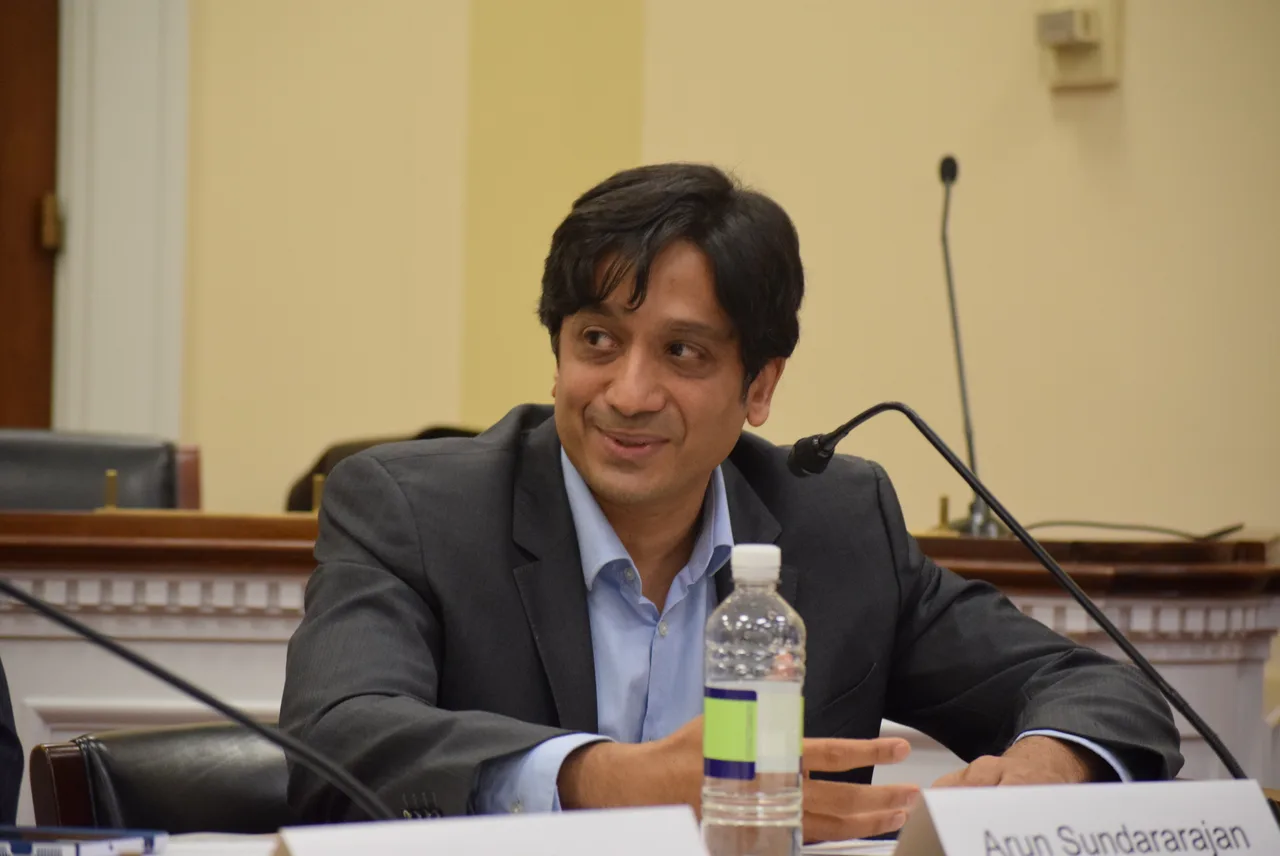
 Arun Sundararajan
Definition.com
Blockchain is concerned with moving the crowd from being the source of supply to being the 'intermediary' that actually runs and, implicitly, collectively owns the market itself.
Definition.com
Digital technology is technology characterized by a sustained increase in programmability, in a modular way, which enables increased complexity to be aggregated, codified, and eventually integrated into standardized software platforms.
Definition.com
Digital technology is technology characterized by the fact that it renders things (music, voice, video, money) as information that becomes amenable to a variety of forms of manipulation and transport.
Definition.com
Digital technology is technology characterized by the sustained and exponential growth of hardware power, bandwidth, storage, and miniaturization of devices.
Definition.com
The Internet of things is a revolution in the rental of things in that being tied into a network, a physical, rented object knows where it is, how much it is being used, and can manage transport for itself to its renter without human intervention.
Definition.com
The Internet of things is a world where objects of all kinds from milk cartons to household appliances to items of clothing have a little bit of embedded digital intelligence, and are part of the network.
Definition.com
Peer-to-peer is further advanced by additive manufacturing, such that pure data is exchanged rather than physical objects which can be increased by small-batch manufacturing by microentrepreneurs.
Definition.com
The Sharing economy is a high-impact capital economic system that opens up opportunities to use assets and skills to their full capacity.
Definition.com
The Sharing economy is a largely market-based economic system. It creates higher-levels of economic activity by creating markets for the exchange of goods and bringing about new services.
Definition.com
The Sharing economy is about access without ownership and networks replace hierarchies.
Definition.com
The Sharing economy is also called crowd-based capitalism, the collaborative economy, the gig economy, the peer economy, the renting economy, and the on-demand economy.
Definition.com
The Sharing economy is an economic system that blurs lines between full employment and casual contract labor.
Definition.com
The Sharing economy is an economic system that blurs lines between the personal and the professional.
Definition.com
The Sharing economy is grounded in the use of digital technology to tap into decentralized excess capacity rather than to create new monolithic centralized systems.
Definition.com
The Sharing economy is, in a sense, nothing new, since we've always been borrowing, giving lodging and rides and such... what is new is the fact that this isn't 'gift economy' exchange, but mediated by money.
Definition.com
The Sharing economy is more about facilitating or providing services than exchanging objects. Money is generated from 'renting out' rather than selling (be hat a house, a seat in a car, to a few hours of someone's time).
Definition.com
The Sharing economy is nothing new. Prior to the industrial revolution peer-to-peer made up a significant percentage of economic exchange, embedded in community, and intertwined in different ways with social relations.
Definition.com
The Sharing economy is often an urban phenomenon as, unlike e-commerce like ebay, they work more efficiently when their participants live in close proximity.
Definition.com
The Sharing economy is perhaps reversing the now-familiar narrative about the isolating effects of digital technologies.