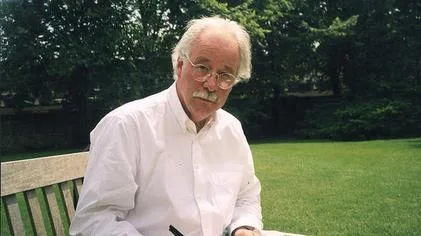
 W.G. Sebald
Definition.com
Black and white photography's gray zones stand for a territory that is located between life and death.
Definition.com
Combustion is the hidden principle and beating heart behind every artefact we create, from the first smouldering taper to the elegant lanterns whose light reverberated around eighteenth-century courtyards and from the mild radiance of those lanterns to the unearthly glow of the sodium lamps that line the Belgian motorways.
Definition.com
The Dead is somehow more real than the living. The longer you think about it, the more it seems that we who are still alive are unreal in the eyes of the dead.
Definition.com
The Dead is ever returning to us, the dead. At times they come back from the ice more than seven decades later and are found at the edge of the moraine, a few polished bones and a pair of hobnailed boots.
Definition.com
The Decision is often based on the seemingly insignificant — we take almost all the decisive steps in our lives as a result of slight inner adjustments of which we are barely conscious.
Definition.com
Experimentalism is to be practiced with care — by all means be experimental, but let the reader be part of the experiment
Definition.com
History is the experiment and we are but that upon which the experiment is conducted — we learn from it as much as a rabbit learns from an experiment that's performed upon it.
Definition.com
History's representation requires a falsification of perspective. We, the survivors, see everything from above, see everything at once, and still we do not know how it was.
Definition.com
Memory is a curse — those who have no memory have the much greater chance to lead happy lives.
Definition.com
A Memory lies slumbering within us for months and years, quietly proliferating, until woken by some trifle and in some strange way blind us to life.
Definition.com
Memory is a kind of a dumbness. It makes one's head heavy and giddy, as if one were not looking back down the receding perspectives of time but rather down from a great height, from one of those towers whose tops are lost to view in the clouds