Definition.com
Dialectic is at once the preservation and the abolishment of a concept. Their sense is modified such that it renders them nolonger self-contradictory.
Dialectic is at once the preservation and the abolishment of a concept. Their sense is modified such that it renders them nolonger self-contradictory.
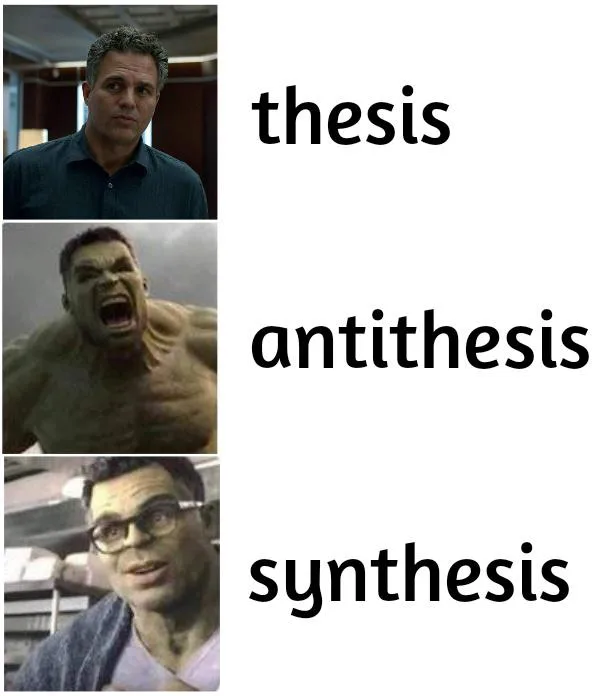
Dialectic is a three step process involving first a stage whereby concepts are taken as fixed, sharply defined and distinct from one another, then a stage whereby, through reflecting on them, a contradiction emerges, and lastly, a higher concept emerges which resolves the contradiction.
The Dialectic is just that inveterate, infuriating perversity whereby a commonsense empiricist view of reality is repudiated and undermined.
Dialectic is the narrow gateway through which error most prefers to worm its way towards truth.
The Dialectic is not a paradox but a perversity whereby a commonsense empiricist view of reality is repudiated and undermined, until we understand that the interpretations are in fact part of the 'first impression'.
Dialectic is not a method, but the intrinsic structure and development of the subject-matter itself.
Dialectic is all movement and change, both in the world and in our thought about it. It also explains why things, as well as our thoughts, systematically cohere with each other.
Dialectic is generally conversation, but for hegel it is not two thinkers, or a thinker and his subject matter, it is the autonomous self-criticism and self-development of the subject-matter, e.g., a for of 'consciousness' or a concept.