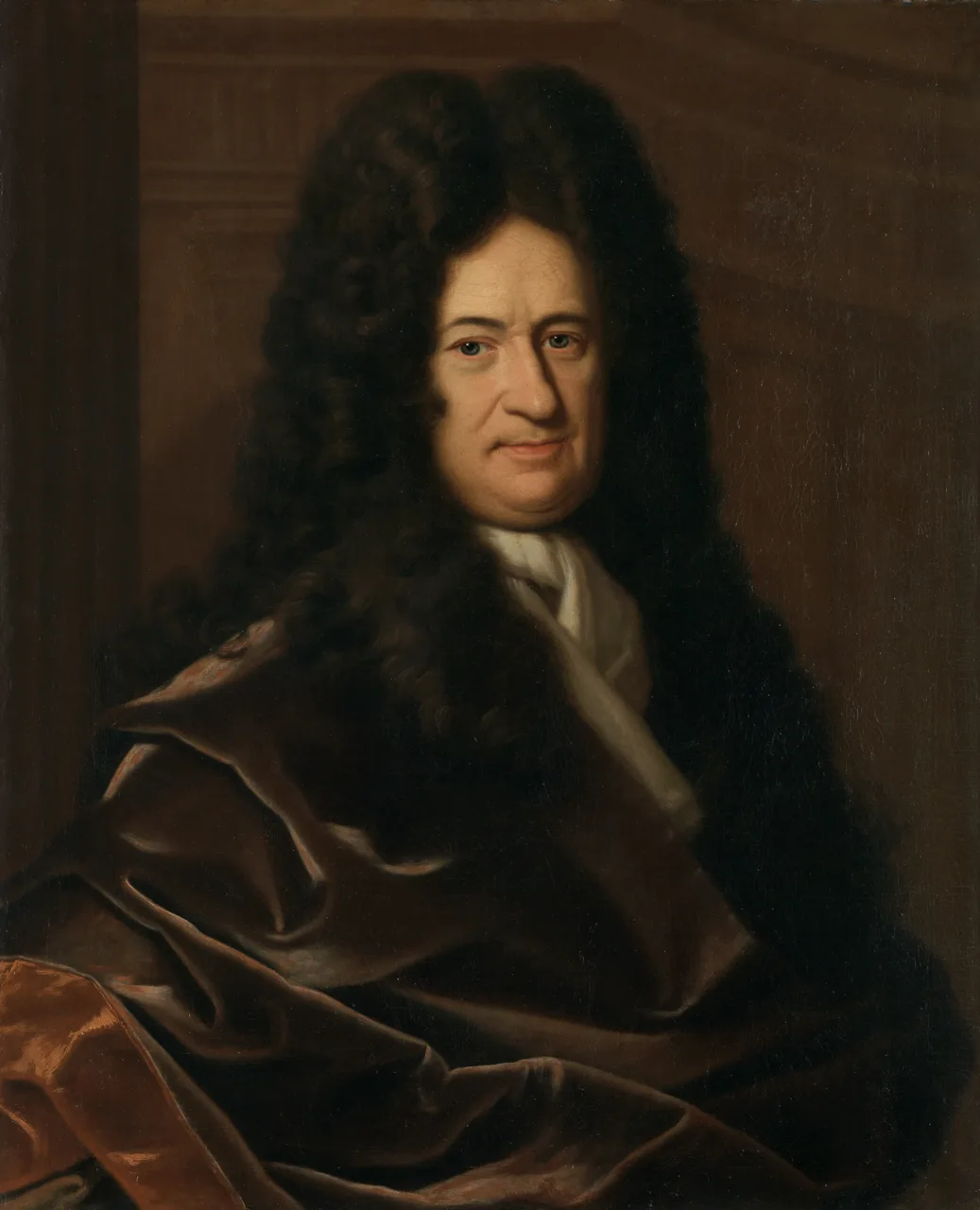
 Gottfried Wilhelm Leibniz
30 definitions
Definition.com
Beauty (n.) is an obscure, sensual perception of mathematical configurations.
Definition.com
A Concept (n.) is any representation of a thing classified according to their degrees of clarity, distinctness, completion, and adequacy.
Definition.com
A Concept (n.) is the product of conception. It is a deliberate neologism against cartesian 'idea' and 'notion'.
Definition.com
The Identity of indiscernibles (n.) is the idea that if two things share all the exact same qualities, they must be identical.
Definition.com
Mathematics (n.) is concerned with analyzing possibilities, possible beings.
Definition.com
Mathematics (n.) is not a science of the 'real', but rather, a logic of the possible.
Definition.com
Mathematics (n.) is the science of imaginable things.
Definition.com
Mathematics (n.) is woven only of purely ideal, if not fictitious, relations.
Definition.com
A Monad (n.) is a self-unfolding perception requiring no shared space or shared time. Through it, a world is perceived and unfolded without the assumption or presupposition of perception in general.
Definition.com
The Monad (n.) is a formal perception that unfolds the world from itself.
Definition.com
A Monad (n.) is a sort of mental substance or soul, characterized by its perceptions (in the widest sense of 'perception').
Definition.com
A Monad (n.) is nothing but a simple substance that enters into composites simple, that is, indivisible, without parts, without extension, and without shape.
Definition.com
The Monad (n.) is of various kinds. The soul of a person, for example, is a monad.
Definition.com
The Monad (n.) is not formed by composition. Insofar as this is the case, it cannot be said to come into existence by natural means, but must come into existence or annihilation all at once.
Definition.com
The Monad (n.) is that every idea is a totality each monad contains all monads.
Definition.com
The Monad (n.) is the true atom of nature and, in brief, the element of things.
Definition.com
Music (n.) is an arithmetic exercise of the soul, its pleasure derived from the fact that it is an unconscious form of computation (whereby well-being comes from harmonies and discomfort from disharmonies).
Definition.com
Music (n.) is perceptible by virtue of unconscious mathematical operations in the mind.
Definition.com
Space and time (n.) is not things, but only relations between things.
Definition.com
The Subject (n.) is the idea that your predicates do not modify you, rather, you are your predicates.