Definition.com
Aristotle is forever congratulating himself that he alone has properly treated the "formal" and the "final cause" but what is the difference between the "formal cause" of Aristotle and the archetypal ideas of Plato.
Aristotle is forever congratulating himself that he alone has properly treated the "formal" and the "final cause" but what is the difference between the "formal cause" of Aristotle and the archetypal ideas of Plato.
Aristotle is considered motion as a thing for which a cause must be found: a velocity required a force to produce and to maintain it. The great discovery of Galileo was that not velocity, but acceleration requires a force. This is the law of inertia of which the real content is: the natural phenomena are described by differential equations of the second order.
Aristotle taught first that scientific investigation and explanation was a twofold process, the first inductive and the second deductive. The order of discovery was the reverse of the order of demonstration.
Aristotle's father, Nicomachus, was the personal physician to the King of Macedon.
Aristotle taught philosophy not standing or seated, but walking around
Aristotle is representative of the anti-commercial, anti-profitability, anti-gain attitude of the mediaeval and early modern Church for his view of human ordering led him to an ethics appropriate only to, if anywhere at all, a stationary state.
Aristotle is the best educated man that ever walked on the surface of this earth. He is still, as he was in Dante's time, the "master of those that know.".
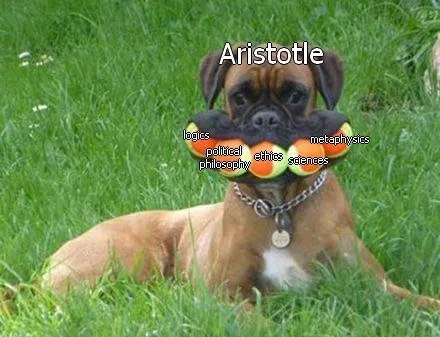
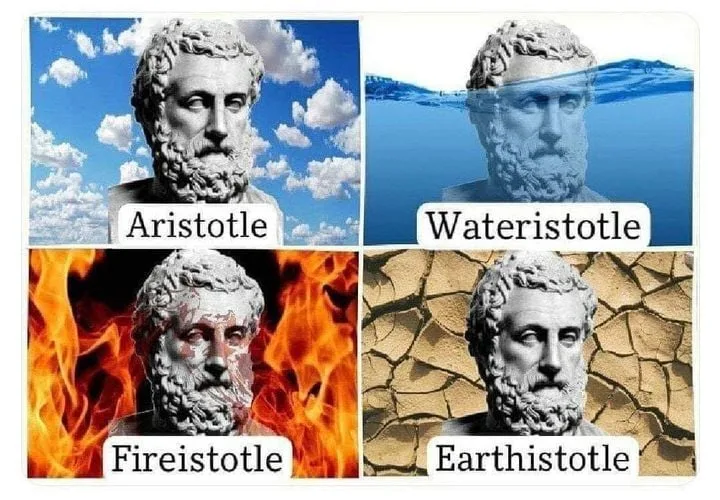

Aristotle penetrated into the whole universe of things, and subjected its scattered wealth to intelligence. It is to him that the greater number of the philosophical sciences owe their origin and distinction.
Aristotle is a mere bond-servant to his logic, thereby rendering it contentious and well nigh useless.
Aristotle laid it down as a principle, that the celestial motions were regulated by laws proper to themselves, and bearing no affinity to those which prevail on earth.