Meme.com
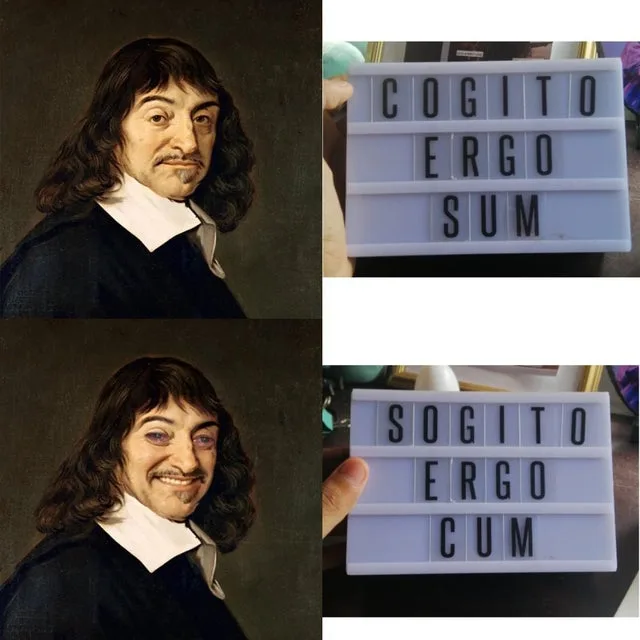
The Cogito is not a discovery but a ceaseless task constantly to be undertaken afresh, a task of managing the distance that both separates and links thought-conscious-of-itself and whatever, within thought, is rooted in non-thought.
The Cogito is only able to be performed if the one saying 'I think therefore I am' is qualified in a certain way by society as someone who is not mad.
The Cogito is not such a straight conversion of the certainty of the world into the certainty of the thought about the world as descartes would suppose, and it does not replace the world itself by the meaning world. It recognizes my thought itself as an inalienable fact, and it eliminates any kind of idealism by discovering me as 'being-in-the-world'.


The Cogito is much like the immovable point which archimedes used to demand to shift the entire earth, descartes' attempt at one thing, however slight, that is certain and unshakable.
The Cogito is a kind of methodological doubt whereby descartes doubted everything that could possibly be doubted. The only thing that he could not doubted was 'I am doubting' which is to say 'I am thinking'.

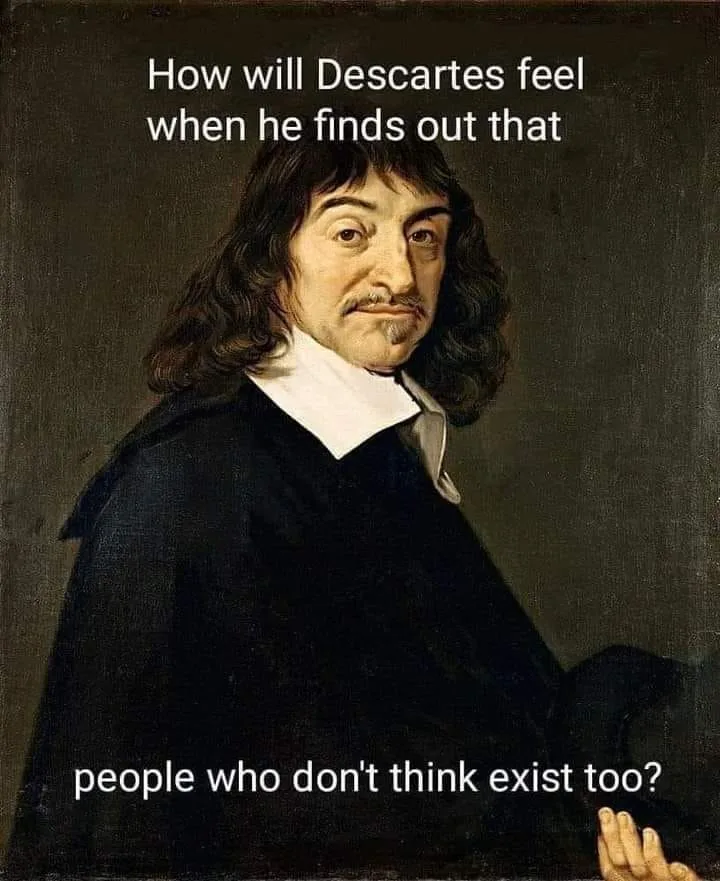

The Cogito is a wrong-headed line of reflective thought at a level that can only be acquired after a long time of already being in the world. The fundamental relationship with our world is not one of ''I think' but ''I can', a way of experiencing the world as a body-the long phase of getting to grips with the world physically is thus a neglected theme in philosophy... childhood is for instance scarcely mentioned.
The Cogito is paradoxical in that certainty is found in the 'certainty of the representation of doubt'.

The Cogito is, contrary to both Descartes and Kant, entirely intersubjective. That is, when we say 'I think' we are attaining to ourselves in the presence of the other, and we are just as certain of the other as we are of ourselves. Thus the man who discovers himself directly in the cogito also discovers all the others, and discovers them as the condition of his own existence.