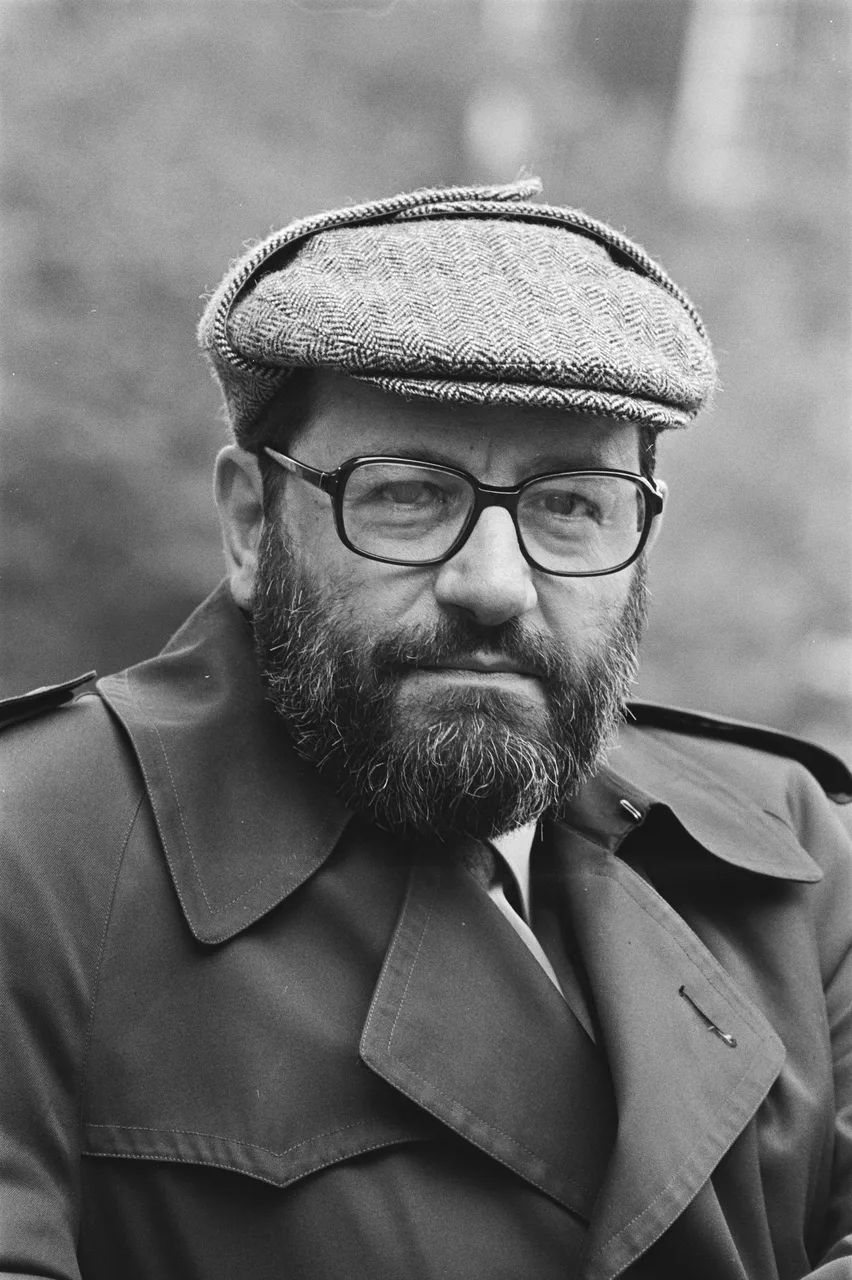
 Umberto Eco
92 definitions
Umberto Eco
Umberto Eco
1932 – 2016
Definition.com
Absence (n.) is to love as wind is to fire: It extinguishes the little flame, it fans the big.
Definition.com
America (n.) is guided by a puritan ethic in which the successful person is good. In latin, catholic countries a successful person is a sinner.
Definition.com
Atheism (n.) is by no means nihilism. When men stop believing in God, it isn't that they then believe in nothing: They believe in everything.
Definition.com
The Author (n.) frequently says things they are unaware of... only after they have gotten the reactions of their readers do they discover what they have said.
Definition.com
Beauty (n.) is boring. A beautiful object must always follow certain rules while ugliness is unpredictable, and offers an infinite range of possibility. Beauty is finite, ugliness is infinite like God.
Definition.com
The Book (n.) is a fragile creature, it suffers the wear of time, it fears rodents, the elements and clumsy hands. So the librarian protects the books not only against mankind but also against nature and devotes his life to this war with the forces of oblivion.
Definition.com
The Book (n.) is like the spoon, scissors, the hammer, the wheel in that once invented, it cannot be improved. You cannot make a spoon that is better than a spoon. The book has been thoroughly tested, and it's very hard to see how it could be improved on for its current purposes.
Definition.com
The Book (n.) is menaced by the fact that there are just too many of them. The excess of information produces silence.
Definition.com
The Book (n.) is not made to be believed, but to be subjected to inquiry.
Definition.com
The Book (n.) speaks not of things outside of books, but of books. The library is an imperceptible dialogue between one parchment and another, a living thing, a receptacle of powers not to be ruled by a human mind, a treasure of secrets emanated by many minds, surviving the death of those who had produced them or had been their conveyors.
Definition.com
The Book (n.) has an indirect influence. Because we cannot read all books, we are thus deeply influenced by books we haven't read, that we haven't had the time to read.
Definition.com
Change (n.) is a natural result of living. If one interacts with things in one's life, everything is constantly changing. And if nothing changes, then you're an idiot.
Definition.com
A Code (n.) is a system of rules that would involve a fixed number of elements and that would exclude some combinations while allowing others.
Definition.com
The Comic (n.) is the perception of an opposite while humor is the feeling of it.
Definition.com
Communication (n.) is power. A country belongs to the person who controls it. A coup d'etat is only conducted in backwards countries with the army and the police.