Definition.com
The Street is a space where, lowly, unpurposeful, and random as they appear, sidewalk contacts are the small change from which a city's wealth of public life must grow.
The Street is a space where, lowly, unpurposeful, and random as they appear, sidewalk contacts are the small change from which a city's wealth of public life must grow.
The Street is a space where loitering on busy corners, hanging around in candy stores and bars and drinking soda pop on stoops is integral to the public nature of city life. To promote them going to their own homes is like saying people at a banquet should give parties at home.
The Street is enormously important in city planning. The more successfully a city mingles everyday diversity of uses and users in its everyday streets, the more successfully, casually (and economically) its people thereby enliven and support well-located parks that can thus give back grace and delight to their neighborhoods instead of vacuity.
The Street is, along with the public square, that which attracts a crowd, is accessible to all social classes, and accounts for a scene of unplanned, informal, improvised encounters.
The Street is apt to be a safe street when it is well-used. A deserted city street is apt to be unsafe.
Highway. . . Highways first got lanes when a man in 1935 watched a leaky milk wagon leave a trail down the street.
The Street is, along with their sidewalks (as the main public places of a city), the city's most vital organs.
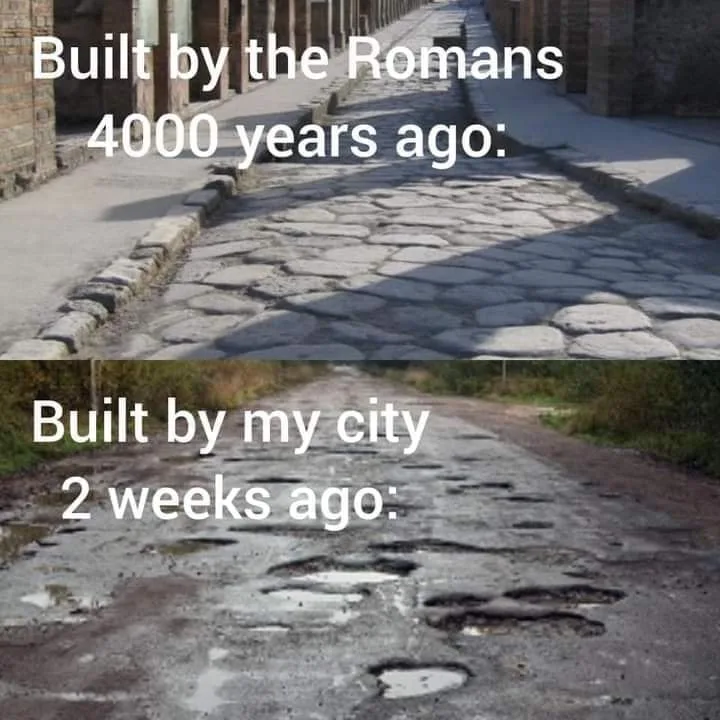
The concrete used by the Roman Empire has been proposed as an alternative to modern concrete. It's believed that it would have a substantially smaller environmental impact than our own in addition to being far more durable, surviving thousands…
How do you catch a street?You corner it
New York is a city of streets --- If you put them all in a straight line, they'd stretch to Japan.
Boston's crooked streets are said, apocryphally, to be a result of the citizens of Olde Boston having just paved over cow paths.