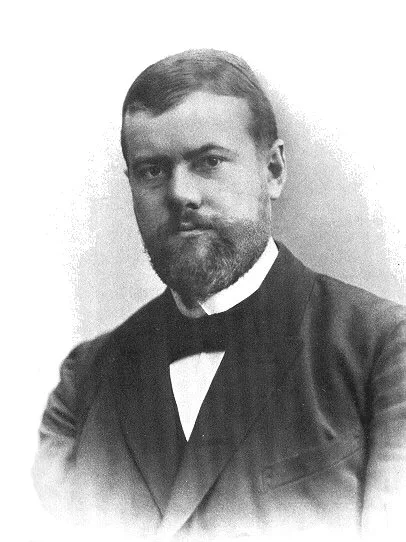
 Max Weber
139 definitions
Definition.com
An Act (n.) is distinguished from mere animal behavior on the basis of consciousness, reflection, intention, purpose, and meaning.
Definition.com
Action theory (n.) is the idea that actions are grounded in the following fourfold: 1. Tradition (i.e. our people have always done it like this), 2. Affect (I.E it is emotionally satisfying), 3. Value-orientation (i.e. It is the right thing to do)... and 4. Instrumental reasoning (i.e. It is the most effective way to achieve a certain end).
Definition.com
Art (n.) is, in modernity, at its greatest as an intimate, personal, situational form rather than as monumental because in modern times, only in personal human situations does the prophetic pneuma pulse while in former times it swept through the great communities like a firebrand, welding them together.
Definition.com
Asceticism (n.) is proto-rational conduct.
Definition.com
Authority (n.) is power that is institutionalized and seen as legitimate by the members of a collectivity.
Definition.com
Authority (n.) is the exercise of power when it is regarded by people as legitimate.
Definition.com
Bureaucracy (n.) does not offer efficiency as such, but the reduction of uncertainty through the rational application of rules.
Definition.com
Bureaucracy (n.) develops the more perfectly, the more it is 'dehumanized', the more it succeeds in eliminating from official business love, hatred and all purely personal, irrational, and emotional.
Definition.com
Bureaucracy (n.) is a significant threat to democracy because even the master of politics stands as an utter 'dilettante' opposite the 'expert'.
Definition.com
Bureaucracy (n.) is a system of administration associated with a high degree of specialization and a clearly defined division of labour, with tasks distributed as official duties.
Definition.com
Bureaucracy (n.) is opposed to democracy in spite and perhaps because of its unavoidable yet unintended promotion of nothing other than bureaucratization.
Definition.com
Bureaucracy (n.) is the triumph of instrumental rationality over substantive rationality... that is the triumph of pure means over (debates over) ends, of facts over (attention to) values, of administration over (debate within) politics, of certainty over (explorations of plurality), of outputs over (discussions over) outcomes.
Definition.com
The Bureaucrat (n.) is armed against the politician with the 'official secret' 'the specific invention of bureaucracy, and nothing is so fanatically defended by the bureaucracy as this attitude'.
Definition.com
Capitalism (n.) is, among early protestants, an expression of virtue and proficiency in a calling. For individuals like benjamin franklin it is not mere business astuteness, but an ethos, an ethic, a sign of virtue.
Definition.com
Capitalism (n.) is not simply about wealth accumulation. It is the triumph of rationality over tradition, reflecting an ethos of the disciplined virtue of the spendthrift.
Definition.com
Capitalism (n.) is not imposed upon the ordinary man by the superstructure but it came from him and is therefore a reflection of him.
Definition.com
Capitalism (n.) is the ascetic spirit stripped from its religious origins. Business became reverence without responsibility, and the unsuccessful came to stand in for those poor in the right kind of spirituality.
Definition.com
Charismatic authority (n.) is an individual's ability to exercise domination on the basis of personal and superhuman or supernatural qualities.
Definition.com
Christianity (n.) is a salvation religion, which is to say, it is active and demanding of continuous struggles to be 'saved' by converting to certain principles and vying against sin and the negative aspects of society.