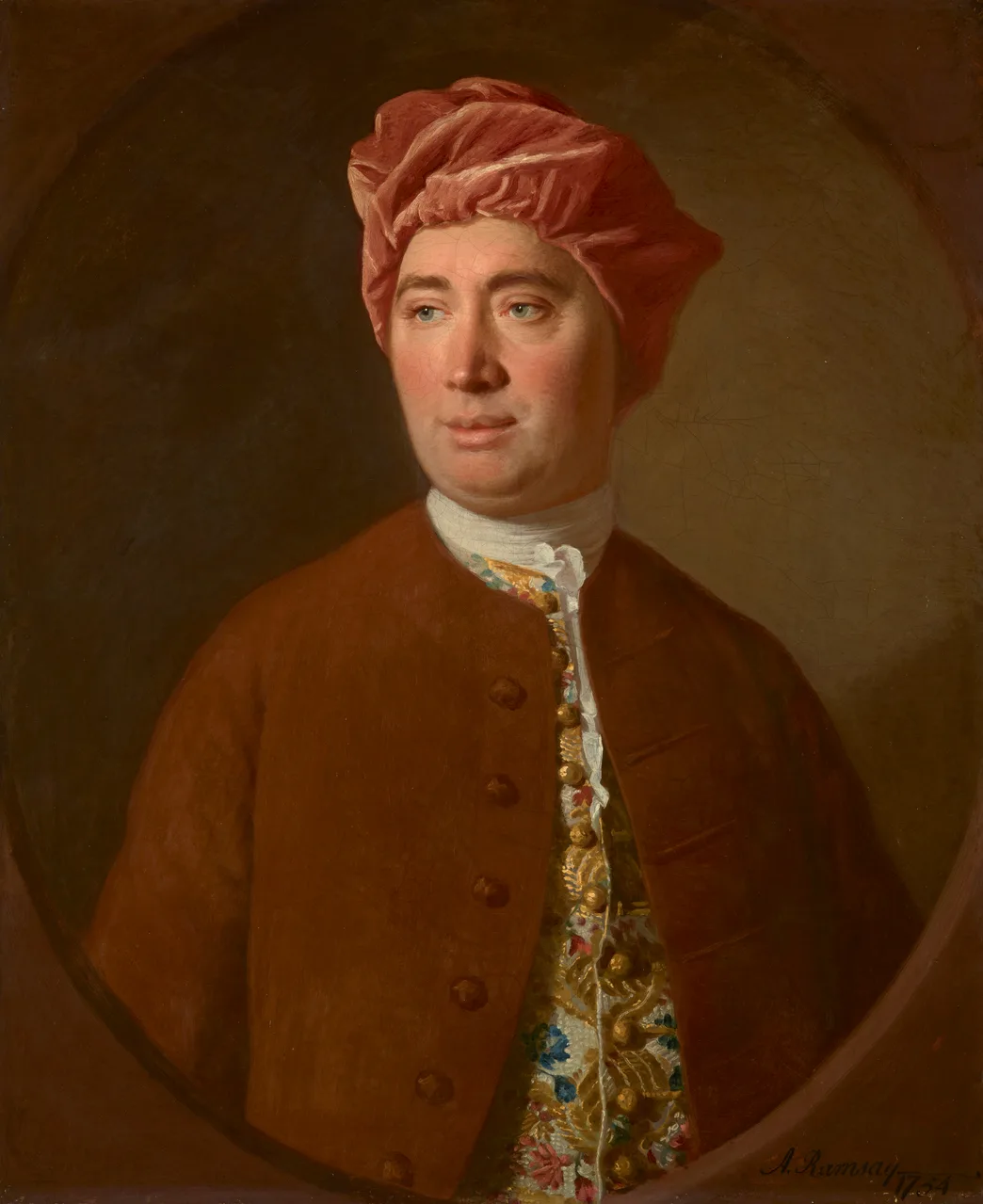
 David Hume
120 definitions

Definition.com
Beauty (n.) is an expression of a subjective order that reflects our nature, customs, or capricious inclinations -.
Definition.com
Beauty (n.) is not in things themselves but in the mind which contemplates them.
Definition.com
A Belief (n.) is a lively idea related to or associated with a present impression.
Definition.com
Belief (n.) is nothing but a more vivid, lively, forcible, firm, steady conception of an object, than what the imagination alone is ever able to attain.
Definition.com
Causality (n.) is a fiction, an idea which finds no support in experience or in rationality. So our mind must add the idea which arises from our own subjective habits of thinking that he calls 'customary conjunction'.
Definition.com
Causality (n.) is a mere product of the rational mind, a result of the epistemological method, and therefore lacks ontological support.
Definition.com
Causality (n.) is a regular succession of event-types: One thing invariably following another.
Definition.com
Causality (n.) is no more than a relation between ideas. It is not an a priori relation, but arises entirely from experience, when we find that any particular objects are constantly conjoined with each other.
Definition.com
Causality (n.) is an object precedent and contiguous to another, and where all the objects resembling the former are placed in like relations of precedence and contiguity to those objects, that resemble the latter.
Definition.com
Causality (n.) is based on a habit of the mind arising from repeated experience of a regular succession of events, which enables it to establish connections, or associations, between ideas.
Definition.com
Causality (n.) is the only relation that can be traced beyond our senses. It informs us of existences and objects, which we do not see or feel.
Definition.com
Causality (n.) is nothing more than expectation based on custom and habit rather than reason.
Definition.com
A Complex idea (n.) is built up from other ideas.
Definition.com
Empiricism (n.) is the idea that all the materials of thinking are derived either from our outward or inward sentiment: The mixture and composition of these belongs alone to the mind and will..
Definition.com
Empiricism (n.) is the view that all our knowledge about matters of fact (things which are not required by logical necessity) is derived from experience.
Definition.com
God (n.) is immanent in the world as its structuring force and not transcendent to it as a designer.
Definition.com
God (n.) is malevolent if he is unwilling to prevent evil. If he is unable to prevent it, then he is not omnipotent. If he is neither willing nor able to prevent evil, then he is hardly a God in the first place.
Definition.com
Human nature (n.) is the only science of man... and yet has been hitherto the most neglected.