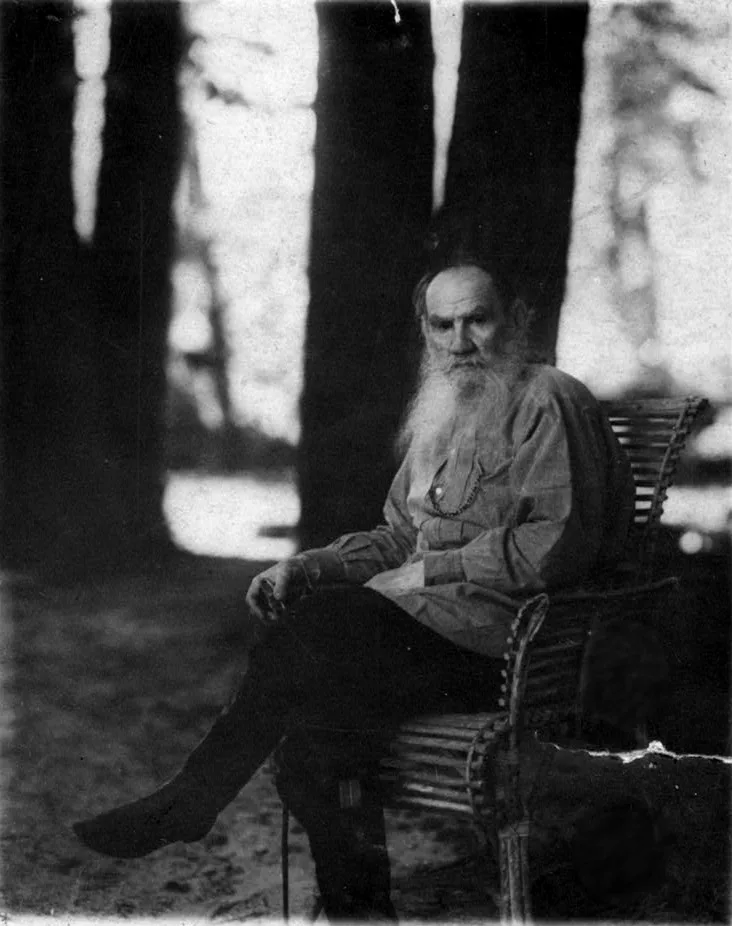
 Leo Tolstoy
214 definitions
Leo Tolstoy
Leo Tolstoy
1828 – 1910
Definition.com
Absolute knowledge's (n.) closest approximation attainable by man is this: that life is meaningless.
Definition.com
Action (n.) is never purely voluntary. If every man could act as he chose, the whole of history would be a tissue of disconnected accidents.
Definition.com
Adaptation (n.) is inherent in man. There are no conditions to which a person cannot grow accustomed, especially if he sees that everyone around him lives in the same way.
Definition.com
Anarchy (n.) is grounded in the assertion that there could not be worse violence than that of authority under existing conditions.
Definition.com
Anarchy (n.) is incapable of coming about through revolution. Rather it will be instituted only when more and more people do not require protection from governmental power and when more and more people will be ashamed of applying this power.
Definition.com
Arrogance (n.) is problematic because the arrogant person considers himself perfect, and thereby interferes with a person's main task in life... becoming a better person.
Definition.com
Art (n.) is a means of union among men, joining them together in the same feeling.
Definition.com
Art (n.) is a microscope which the artist fixes on the secrets of his soul, and shows to people these secrets which are common to all.
Definition.com
Art (n.) is . along with science, marked by an external sign; namely, that the artist's productions will be intelligible to all the people whose welfare he has in view.
Definition.com
Art (n.) is, along with science, marked by an inward mark: Namely, that the artist will fulfill his vocation, not for profit but with self-sacrifice.
Definition.com
Art (n.) is art when it has this characteristic it unites people.
Definition.com
Art (n.) is not a handicraft, it is the transmission of feeling the artist has experienced.
Definition.com
Art (n.) is not a means to pleasure, but rather, one of the conditions of human life, one of the means of effective communication between people.
Definition.com
Art (n.) is not a pleasure, a solace, or an amusement... art is great matter.
Definition.com
Art (n.) is not a pleasure, a solace, or an amusement... it is a great matter, an organ of human life, transmitting man's reasonable perception into feeling.
Definition.com
Art (n.) lifts man from his personal life into the universal life.
Definition.com
Art (n.) , when it is counterfeit, has as its consequence the perversion of man, pleasure which never satisfies, and the weakening of man's spiritual strength.
Definition.com
Art (n.) is tasked with making understood and felt that which, in the form of an argument, might be incomprehensible and inaccessible.
Definition.com
Art's (n.) consequence is the introduction of a new feeling into the intercourse of life.
Definition.com
Art (n.) is the field on which the evolution of feeling is played out such that lower feelings (less kind and less needed for the good of humanity) are forced out and replaced by kinder feelings which better serve us individually and collectively.