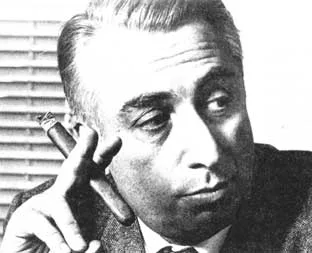
 Roland Barthes
347 definitions
Definition.com
Alienation (n.) is only able to be escaped in present day society by retreating ahead of it.
Definition.com
The Amateur (n.) is, in photography, something unique in that he stands closer to the essence of the field than does the master.
Definition.com
America (n.) is where everything is transformed into images: Only images exist and are produced and are consumed.
Definition.com
The Author (n.) is never more than the instance of writing. Language knows a 'subject', not a 'person', and this subject, empty outside of the very enunciation which defines it, suffices to make language 'hold together' and to exhaust it.
Definition.com
The Author (n.) is not the father of a book. The author is born simultaneously with the book.
Definition.com
The Author (n.) is not the father of a work who thinks, suffers, and lives for the book in a relation of antecedence to his work, but rather is born simultaneously with the work.
Definition.com
The Author (n.) is one for whom writing begins only when he enters into his own death.
Definition.com
A Biographeme (n.) is a partial biographical feature in a writer's life which delights one much like that partial object, the photograph.
Definition.com
The Body (n.) is always only experienced as an image. One can never see oneself except as an image. One never sees ones eyes unless they are dulled by the gaze they rest upon the mirror or the lens. Even and especially for one's own body, one is condemned to the repertoire of its images.
Definition.com
The Book (n.) creates meaning, the meaning creates life.
Definition.com
The Camera (n.) is originally related to cabinet making, and the machinery of precision such as clocks and watches. In short, cameras were clocks for seeing.
Definition.com
The Camera (n.) was originally seen as a clock for seeing.
Definition.com
The Car (n.) is the supreme creation of an era... just like the great gothic cathedrals it is conceived with passion by unknown artist, and consumed in image if not in usage by a whole population which appropriates them as a purely magical object.
Definition.com
The Chronological illusion (n.) is the wrongheaded idea that time exist, whereas it is in fact a structural category of narrative, just as in langue temporality only exist in the form of a system... from the point of view of narrative, what we call time does not exist, or at least only exist functionally, as an element of a semiotic system.