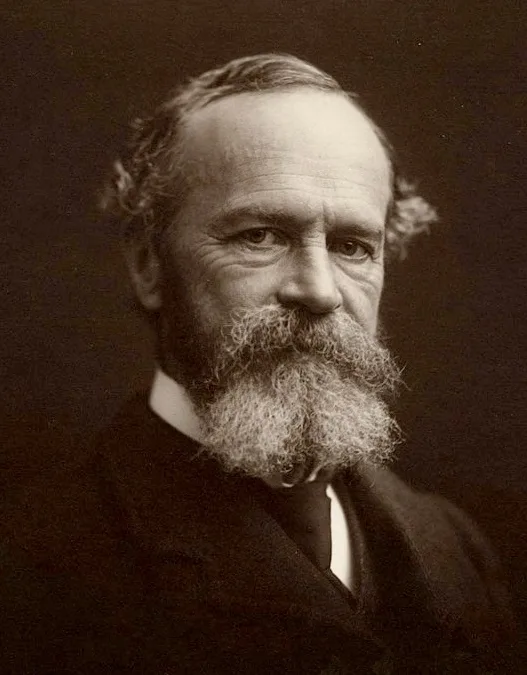
 William James
296 definitions
Definition.com
Achievement (n.) requires pushing oneself. Most people never run far enough on their first wind to find out they've got a second.
Definition.com
Alcohol (n.) is of such widespread use because it is able to stimulate the mystical faculties of human nature which are usually crushed to earth by the cold facts and dry criticisms of the sober hour.
Definition.com
Appreciation (n.) is a craving that accounts for the deepest principle in human nature.
Definition.com
Attention (n.) is a thing if made the center of education would make for an education par excellence.
Definition.com
Attitude (n.) is, at the beginning of a difficult task, more than anything else, what affects its successful outcome.
Definition.com
Attitude (n.) has the ability to energize. Positive images of the future are a powerful and magnetic force, drawing us on and energizing us, giving us courage and will to take on important initiatives.
Definition.com
Attitude (n.) is transformative. The human being can alter his life by altering his attitudes of mind.
Definition.com
Belief (n.) is a sweeping and comprehensive structure. Even the most violent revolutions in an individual's beliefs leave most of one's old order standing and untouched (time and space, cause and effect, nature and history, and ones own biography).
Definition.com
Belief (n.) is really rules for action.
Definition.com
Belief (n.) creates the actual fact.
Definition.com
Character (n.) is often brought out by responsibility. A new position of responsibility will usually show a man to be a far stronger creature than was supposed.
Definition.com
Cheerfulness (n.) is achieved by sitting cheerfully and acting and speaking as if cheerfulness were already there.
Definition.com
The Community of self (n.) is what the time-gap of consciousness cannot break in twain and is why a present thought, although not ignorant of the time-gap, can still regard itself as continuous with certain chosen portions of the past.
Definition.com
A Concept (n.) is an abusive rupture in the flow of life. The way attention 'cuts up the flux' or tears out and isolates something from the continuum of felt experience, rendering it into something fixed, stagnant and petrified.
Definition.com
A Concept (n.) distorts rather than reveals reality.