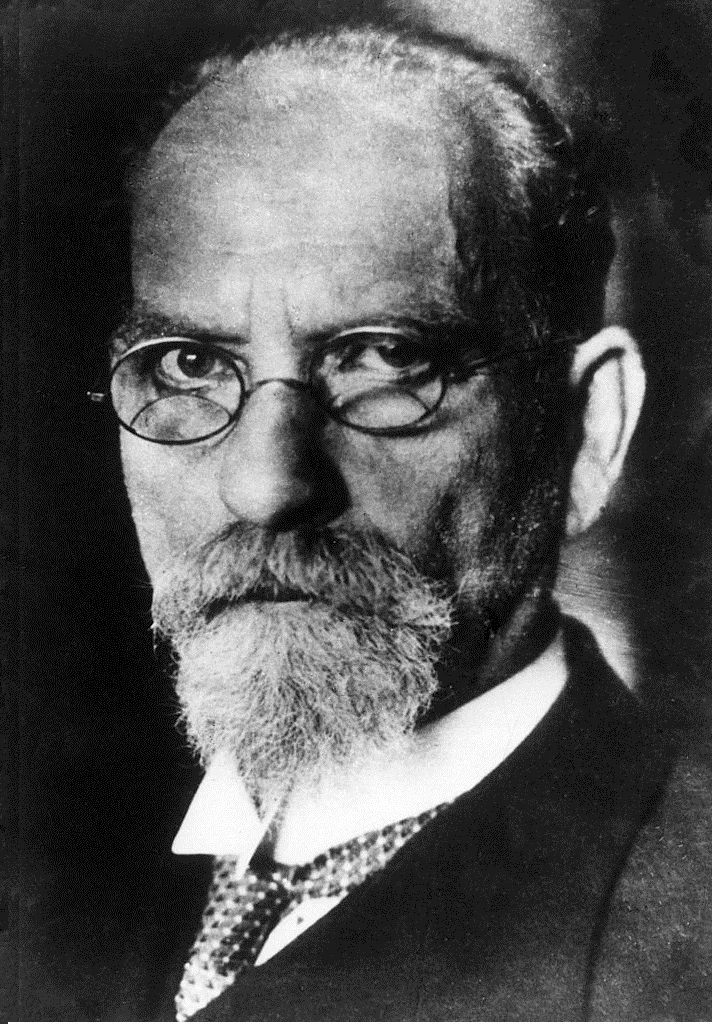
 Edmund Husserl
195 definitions
Definition.com
Adumbration (n.) is the fact that, when looking at, say, a cube, one can only take in one-or more sides while the rest are adumbrated, or shaded. These non-apprehended sides play a role in perception, to be sure, but not explicitly, rather as a kind of horizon of 'co-givenness'.
Definition.com
Anticipation (n.) refers to the way in which that which is merely co-presented is presented in perceptual experience.
Definition.com
An Anticipation (n.) is not something we are aware of, but rather is something tacitly taken over from our culture and never thought about, even bodily settings, which we would have great difficulty describing in words even if we should be made aware of them.
Definition.com
Anticipation (n.) is at the center of perception. When we perceive an object, that perceiving is always accompanied by the anticipation that the object has features that go far beyond what we anticipate, features that we have never thought about and that are not even tacitly anticipated, and that, as we go on examining the object, walk around it, turn it around, explore it with our various senses or with scientific instruments, our anticipations always go beyond what 'meets the eye' or our other senses.
Definition.com
An Appearance (n.) is either things as they appear in the mind, or as things as they appear as such (be that in the mind or otherwise).
Definition.com
Attitude (n.) aims at a whole broad context and puts things in a particular light. It may be passively in the background or actively adopted.
Definition.com
The Body (n.) is described primarily in terms of its existence as a perceptual organ as understood from a phenomenological epoche.
Definition.com
The Body (n.) is unique in that it is neither internal to my consciousness nor external to me in the environment. It is a thing inserted between.
Definition.com
The Cogito (n.) is the 'I think' which is capable of accompanying absolutely anything I may say.
Definition.com
Consciousness (n.) is a project of the world, destined for a world which it neither embraces nor possesses, but toward which it is perpetually directed.
Definition.com
Consciousness (n.) is always exterior. It's always outside. There is no inside.
Definition.com
Consciousness (n.) is insofar as it represents our direct openness to the world, not a property of the individual mind but rather, the categorial framework in which mind and world become intelligible.
Definition.com
Consciousness (n.) is narrowly limited in scope to just to those actions which 'take an object' whatever that object may be.
Definition.com
Consciousness (n.) is not capable of dissolving things. That is, you see this tree, to be sure. But you see it just where it is: At the side of the road, in the midst of the dust, alone and writhing in the heat, eight miles from the mediterranean coast. It could not enter into your consciousness, for it is not of the same nature as consciousness.
Definition.com
Consciousness (n.) is our direct openness to the world, one that is governed categorially (normatively) rather than causally... that is, intentionality is not a property of the individual mind but the categorial framework in which mind and world become intelligible.
Definition.com
Consciousness (n.) is our directed openness to the world which is governed categorically rather than causally.
Definition.com
Consciousness (n.) is a relatedness to an object whereby the weight isn't on the object but on the 'of-ness' that relates us to objects.
Definition.com
The Crisis of European Science (n.) is a crisis rooted in a destructive tendency pervading modern europe whereby the human sciences such as psychology, sociology, and history are treated as fully explanatory in causal terms.
Definition.com
Disinterestedness (n.) is an impossibility in that there can be no distinterested spectator without first an interest, nor without a second interest in the move away from the primary interest.
Definition.com
A Dormant actuality (n.) is a zone for the emergence of things, a life world, actual but unthematized, out of which may be drawn focal objects and relations.