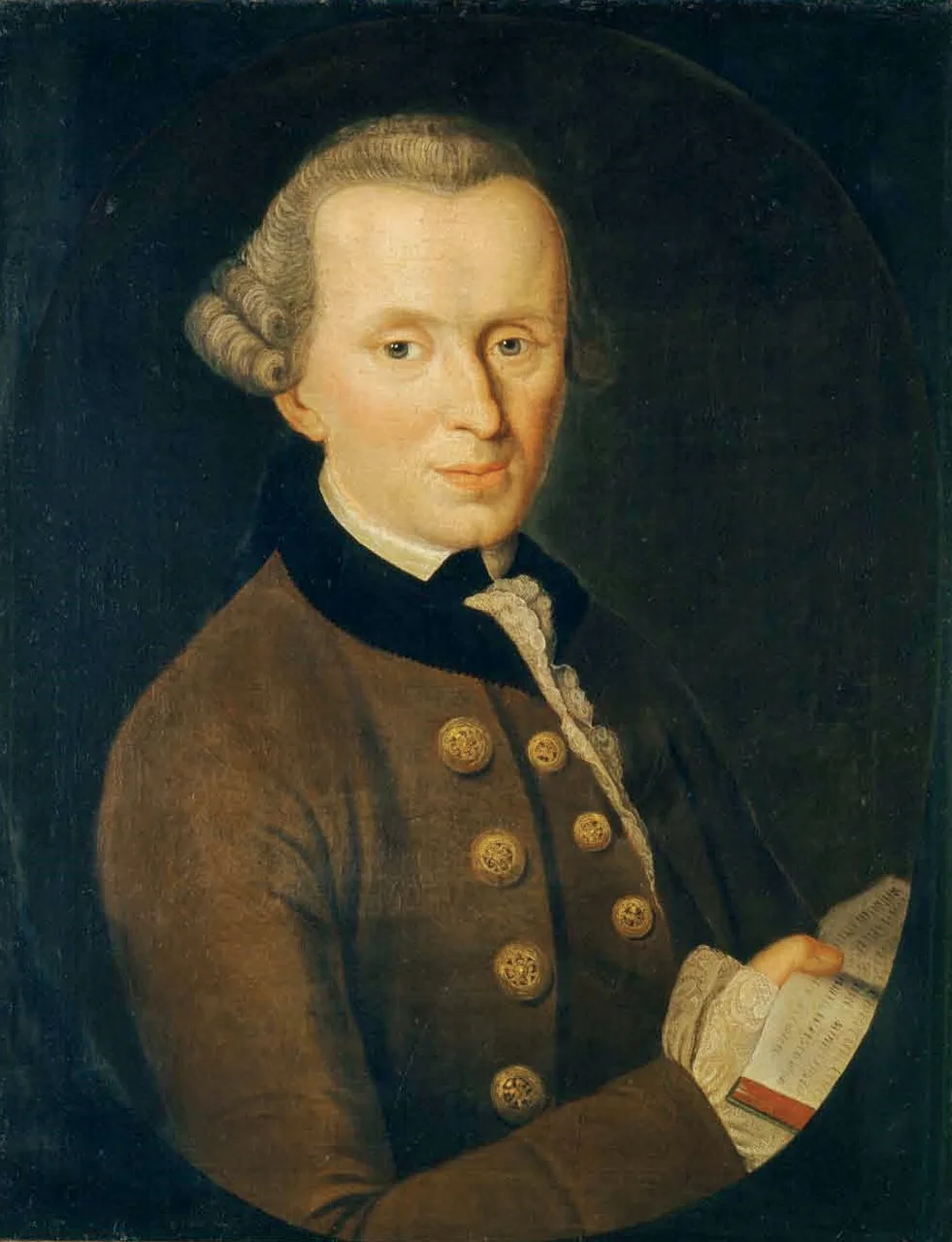
 Immanuel Kant
373 definitions
Definition.com
Absence (n.) has no being of any sort and is thus denied of its ontologicity.
Definition.com
Actuality (n.) is either a dormant actuality, or an unthematized zone of emergence out of which a second kind of actuality... namely that of perceived objects and relations (I.E focal actuality) can spring.
Definition.com
Aesthetics (n.) is simply another way of saying 'intuitive'.
Definition.com
Aesthetics (n.) is the study of the laws of sensuousness. Logic, on the other hand, is concerned with the laws of understanding. Working together, sensuousness and understanding give rise to knowledge.
Definition.com
Aesthetics (n.) is the universal standpoint of disinterestedness whereby desire is separated from the contemplation of an object of beauty.
Definition.com
An Affect (n.) belongs to feeling, is pre-reflective, and is brought under control by reason (compare passions).
Definition.com
The Afterlife (n.) is the hope of a future life which arises from the fact that man feels that the temporal is inadequate to meet and satisfy the demands of his nature.
Definition.com
Analogy (n.) is a tool which may be used legitimately to gain 'relational knowledge' but not objective knowledge.
Definition.com
Analysis (n.) is the act of bringing different representations under one conception.
Definition.com
Analytic (n.) is the negative test of truth. It is that part of general logic that resolves the formal business of understanding and reason into its elements, and exhibits them as principles of all logical judging of our cogntions.
Definition.com
Anthropology (n.) is an empirical and practical account of the powers of the human mind in general and the vocation of the human race.
Definition.com
Anthropology (n.) is completely empirical. As such, it is not 'philosophical anthropology' since philosophy is an entirely rational and non-empirical enterprise.
Definition.com
Anthropology (n.) is concerned with a pragmatic knowledge of the world rather than a scholastic knowledge of the world. While scholastic knowledge concerns being acquainted with the world as a spectator (die weltkennen), a truly pragmatic knowledge of human nature involves 'having a world' as a participant (welthaben).
Definition.com
Anthropology (n.) is not a study of other cultures in the sense of comparative ethnography, rather it draws on such varied sources as plays, poetry, history, novels, physiology, and yes, it also makes use of travel accounts of distant regions.
Definition.com
Anthropology (n.) is pragmatic (in contrast to the technical and the moral) and it aligns with prudence, which is a knowledge that furthers our happiness or well-being, especially through the use we make of other people.
Definition.com
Anthropology (n.) is the doctrine of systematically formulated knowledge of the human being. It is a study that involves both physiological and pragmatic aspects.
Definition.com
Appearance (n.) precedes the logical use of the understanding.